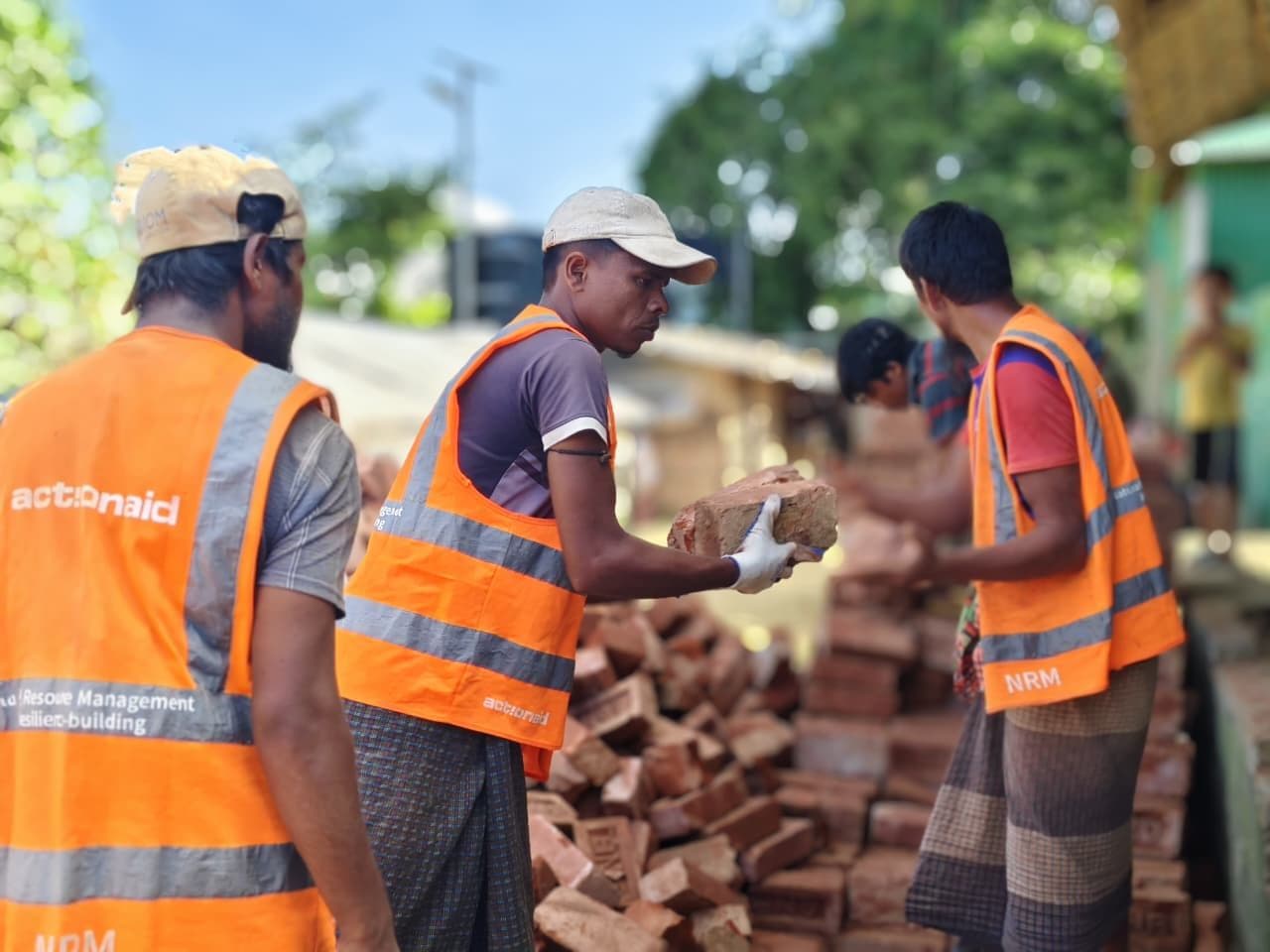
The ActionAid Bangladesh (AAB) WFP-funded Natural Resource Management (NRM) project officially commenced on 16 February 2025, to strengthen natural resource management to create resilient communities, support livelihoods, and promote environmental sustainability for both the Rohingya refugee and host communities.
The project focuses on community-led approaches through three core activities:
• Climate Resilience Infrastructure schemes : Construction of slope stabilisation structures, HBB roads, box culverts, and drainage systems to reduce disaster risks and improve mobility.
• Drainage Cleaning Activities (DCA): Large-scale cleaning of drainage networks across camps to prevent waterlogging and improve hygiene.
• Reforestation Care & Maintenance (RCM): Plantation and maintenance of trees in camps and host areas to restore degraded land and enhance biodiversity.
These interventions cover Camps NRC, 22, 24, 25, 26, 27 and host areas in Cox’s Bazar Sadar, Ramu, Ukhiya, and Teknaf upazilas, including 8 beat offices under the Bangladesh Forest Department. The project integrates cash-for-work opportunities, ensuring livelihood support for vulnerable groups while promoting nature-based solutions (NbS) for climate resilience.
Project Key Outputs
• 36 Climate Resilience Infrastructure completed (Slope Stabilisation, Drainage Construction, HBB Road, Box Culvert) across Camps 22, 24, 25, 26, 27 & NRC.
• 4,79,389 meters of drainage cleaned across the same camps.
• 5,905 individuals from FDMN were directly engaged through Cash for Work (2% Persons with Disabilities, 25% Female, 75% Male).
• 678 individuals from host communities engaged through Cash for Work (31% Female, 69% Male).
• A total of 268.82 hectares of reforestation sites have been covered, with 297,544 saplings planted through new plantations and gap-filling activities across camps and host community areas.
• In Camps 22, 24, 25, 26, 27, and NRC, plantation, gap-filling, and care & maintenance activities were implemented over 16.52 hectares, supporting 11,894 saplings under active care and maintenance.
• Gap-filling and new plantation activities were carried out across Teknaf unions and forest beats, covering 13.17 km of roadside plantations and 10.58 ha of institutional areas, plus enrichment plantations and gap-filling over 240 ha in forest ranges, planting 285,650 saplings (including 105,000 new and 170,000 gap-filling).