Making Market Work for Women (MMWW)
Introduction
The Theory of Change (ToC) of the projectMaking Market Work for Women(MMWW) flows from the understanding of the situation of constraints inhibiting access to market which is imperfect and biased against the people living in poverty. For women, this constraining condition is double-edged in the sense that they do not get access to service providing and local market institutions on the one hand and their productive role is officially unrecognized due to prevailing notions about value of women’s work on the other. The double-edged constraint as such is reinforced by the stereo-typed gender division of labor where they are perceived as the farm wives rather than independent collectives of women in agricultural entrepreneurial activities. All these constraints have laid the foundation of MMWW initiative with a proposition of whether market could be made work for women.
In overcoming the above constraints, MMWW project has broadly articulated SRHR (Sexual and Reproductive Health Rights) and Food and Nutrition Security (FNS) as three major pillars of intervention in theorizing the change that could create an enabling market environment that works for women.
Background
Agriculture Status:
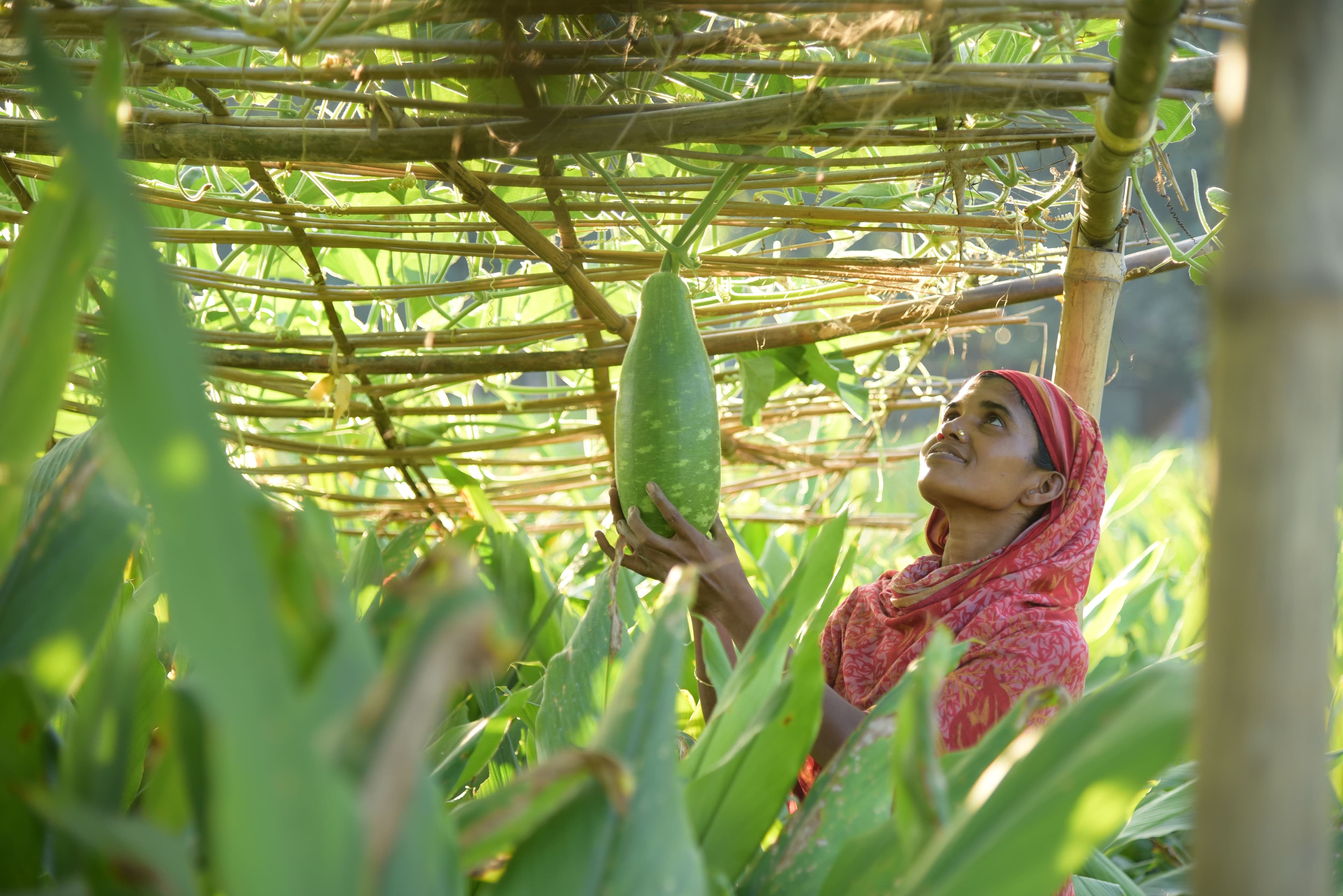
Agriculture is the largest employer in the country by far; 47.5% of the population is directly employed in agriculture. Women constitute about 46% of the total farming population. However, they do not have adequate opportunity and skills to conduct business lack adequate representation and voice in the decision-making processes. A major obstacle is their isolation from the agricultural value chain and male actors who dominate the value chain take advantage of this isolation.
Nutrition Status:
Bangladesh Demographic and Health Survey (BDHS) 2011 states that 41% of under-five children are stunted (15.3% severely stunted); this is more prevalent among rural children (43%) than urban children (36%). The prevalence of underweight children is 36%, with 10.4% being severely underweight. On average the incidence of severe malnutrition among girls under five is 2-4% higher than among boys.
Sexual and Reproductive Health:
Since ICPD and Beijing 4thWorld Conference on Women, SRHR concept received commendable policy attention. As a result, Adolescent Reproductive Health Strategy and National Action Plan on ASRHR were produced in 2006 and 2013 respectively from DG Family Planning. However, on the question of implementation of these important policy documents, Sexually active and/or married men and women do not have clear conceptual knowledge of SRHR nor how to incorporate it into their individual and family lives.
Keeping the above context in mind, MMWW emphasized on awareness raising on sexual and reproductive health rights and nutrition, and capacity building of Community Group and Community Support Group of Community Clinic (CC) on their roles and responsibilities to create SRHR and nutrition sensitive community. In addition, the project focused on strengthening linkages with online market platform with women entrepreneurs’ and promotion of e-commerce for ensuring the sale of agri-products. Lastly, the project also facilitated the process of strengthening the linkages of women entrepreneurs with national level e-market place and other market actors.